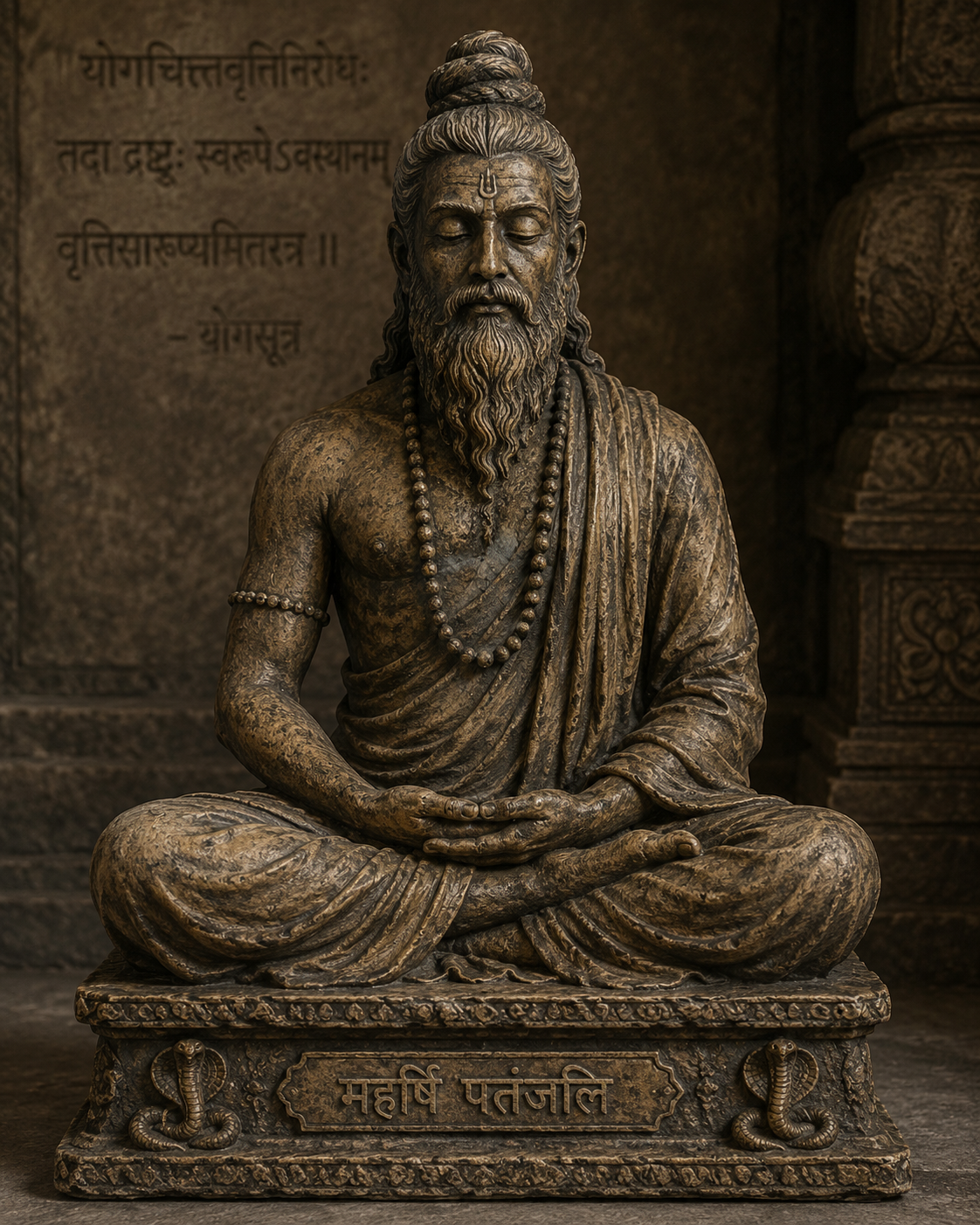
Understanding the Heart of Yoga
Explore the profound definition of yoga from Patanjali's Yoga Sutras — a timeless guide to mental stillness, self-realization, and inner peace.
This comprehensive resource separates established facts from traditional beliefs and modern claims, providing evidence-based insights into one of philosophy's most influential teachings.
The Definition of Yoga
Patanjali's Yoga Sutra 1.2 provides the classical definition of yoga in just four Sanskrit words, establishing the foundation for the entire yogic philosophical system.
yogaś citta-vṛtti-nirodhaḥ
"Yoga is the restriction/cessation/stilling of the modifications (vṛttis) of the mind-stuff (citta)"
Yogaḥ
योगः
From the root yuj meaning "to yoke" or "to unite." In this context, yoga refers to the state of union achieved through practice, not the practice itself.
Citta
चित्त
The entire mental field including manas (recording mind), buddhi (discriminating intellect), and ahamkara (ego). Broader than "mind" — encompasses consciousness itself.
Vṛtti
वृत्ति
Modifications, fluctuations, or waves of mental activity. Patanjali identifies five types: correct perception, misperception, imagination, sleep, and memory.
Nirodhaḥ
निरोधः
Restraint, cessation, or stilling. Not violent suppression but natural settling — like muddy water clearing when left undisturbed.
What This Means
At its core, yogaś citta-vṛtti-nirodhaḥ teaches that yoga is the state in which mental-emotional fluctuations have become still. [cite:1][cite:2] This is not about stopping thoughts through force, but rather creating conditions where the mind naturally settles, allowing us to experience our true nature beyond the constant mental chatter. [cite:1]
"When the mental-emotional fluctuations have become still, it's much easier to experience yourself as you fundamentally are. Your essence-nature has always been present throughout your whole life." [cite:1]
The Five Vṛttis (Mental Modifications)
Patanjali systematically categorizes all mental activity into exactly five types in Sutra 1.6, making this teaching both comprehensive and practical. [cite:2][cite:3] Every thought, emotion, or mental event falls into one of these categories:
Correct Perception
प्रमाण (Pramāṇa)
Valid cognition through direct perception, inference, or reliable testimony. Knowledge not deceived by faulty senses or incomplete data. [cite:2][cite:3]
Misperception
विपर्यय (Viparyaya)
Incorrect knowledge or false understanding. Misperceiving reality due to faulty perception, wrong inference, or incomplete information. [cite:2][cite:3]
Imagination
विकल्प (Vikalpa)
Verbal construction or conceptualization without corresponding reality. Fantasy, daydreaming, and mental projections. [cite:2][cite:3]
Sleep
निद्रा (Nidrā)
The mental modification corresponding to dreamless sleep. An altered state where conscious thought patterns are significantly reduced. [cite:2][cite:3]
Memory
स्मृति (Smṛti)
Recollection of past experiences without adding new characteristics. The retention and reproduction of previously experienced impressions. [cite:2][cite:3]
Important Clarifications
Citta includes both thoughts and emotions. In Sanskrit, citta is the locus of both mental and emotional activity — they're not separate. Therefore, the correct translation is "mental-emotional fluctuations," not just "mental." [cite:1]
Yoga is a state, not a practice. For Patanjali, yoga refers to the result of practice — the state of stillness achieved — not the physical postures or techniques themselves. [cite:1]
Nirodha means natural settling, not suppression. Classical commentators emphasize that nirodha is closer to "stilling" than "stopping." The yogi removes conditions that stir the mind; the surface settles on its own. [cite:2]
How to Practice
While the sutra is brief, living it requires dedicated practice. Patanjali provides the eight-limb path (Aṣṭāṅga Yoga) as the method by which nirodha becomes achievable. [cite:2] Here are practical approaches for modern practitioners:
-
Formal Meditation Practice
Sit for 10-20 minutes daily in a stable, comfortable posture. Choose one object of focus — breath, mantra, candle flame, or bodily sensation. Each time a vṛtti arises, notice it, name it (memory, plan, judgment), and gently return to your object. You're not stopping thought; you're practicing not following it. [cite:2]
-
Off-the-Mat Awareness
Several times daily, pause for a single breath and ask: "Which vṛtti is running right now?" Is it memory of yesterday? Plans for tomorrow? A judgment about someone? This brief inquiry interrupts identification with the mental fluctuation and rehearses the witness-stance. [cite:2]
-
Reduce Sensory Input
Modern citta is overwhelmed by infinite-scroll feeds, notifications, and ambient anxiety. Reducing input is itself nirodha practice. Choose one input — a single app, news source, or evening screen time — to withdraw from for seven days. Notice what happens to your mental surface. [cite:2]
-
Yogic Breathing (Pranayama)
Practices like alternate nostril breathing (Nadi Shodhana) and equal breathing (Sama Vritti) quickly calm an agitated mind by regulating the nervous system and creating physiological conditions for mental stillness. [cite:3]
-
Grounding Asanas
Soothing postures like Child's Pose, Supine Bound Angle, and Seated Forward Bend promote deep relaxation and help quiet mental agitation, preparing the body-mind for meditation. [cite:3]
-
Study and Self-Reflection
Regular study of yogic texts (Svādhyāya) and self-inquiry help develop discriminative wisdom (Viveka) to distinguish between the seer (Purusha) and the modifications of mind (Prakriti). [cite:4]
The Eight Limbs Support Nirodha
Patanjali's eight-limb path systematically prepares the practitioner for citta-vṛtti-nirodhaḥ: [cite:4][cite:5]
- Yama & Niyama (ethical restraints and observances) still vṛttis born of unethical conduct and unregulated lifestyle
- Āsana & Prāṇāyāma (posture and breath control) still vṛttis born of physical agitation
- Pratyāhāra (sensory withdrawal) turns attention inward from external distractions
- Dhāraṇā, Dhyāna, Samādhi (concentration, meditation, absorption) refine the inner work that Sutra 1.2 names [cite:2]
Scientific Evidence
Modern neuroscience has begun investigating the neural correlates of yogic practices and meditative states described in the Yoga Sutras. While the philosophical framework differs from scientific materialism, empirical research supports many benefits of practices aimed at mental stillness. [cite:6][cite:7]
Key Research Findings
- Brain Structure Changes: Long-term yoga practitioners show greater resting-state functional connectivity between the medial prefrontal cortex and right angular gyrus, regions involved in self-referential processing and attention. [cite:6]
- Emotional Regulation: Pranayama practices significantly decrease anxiety and negative affect while modulating activity in brain regions involved in emotional processing (amygdala, anterior cingulate, prefrontal cortex). [cite:7]
- Default Mode Network: Meditation experience is associated with reduced activity and connectivity in the default mode network, which is active during mind-wandering and self-referential thought — essentially the neural correlate of vṛttis. [cite:8]
- Attention and Focus: Regular meditation practice improves sustained attention, reduces attentional lapses, and enhances cognitive control — supporting the yogic goal of one-pointed concentration (Ekāgratā). [cite:6]
"Yoga as a practice and philosophy has been followed for more than 4500 years. The last few decades have seen a resurgence in the utility of yoga and meditation with growing scientific evidence behind it." [cite:6]
Limitations and Considerations
It's important to note that while scientific research validates benefits of meditation and mindfulness practices, the metaphysical framework of Patanjali's system — including concepts like Purusha (pure consciousness) and Kaivalya (liberation) — operates outside the scope of empirical science. [cite:9] Science studies the mind (citta) and its modulations, but the yogic goal of realizing the Seer (Purusha) transcends materialist paradigms. [cite:6]
Common Misunderstandings
Despite its popularity, Yoga Sutra 1.2 is frequently misunderstood or misapplied in modern contexts. Here are key clarifications based on scholarly research and traditional commentary:
1. Modern Postural Yoga ≠ Patanjali's Yoga
Of the 195-196 sutras, only three (2.46-48) mention āsana (posture), and those describe it simply as a "steady and comfortable seat" for meditation — not the gymnastic postures of modern yoga. [cite:9] Less than one percent of the text concerns physical postures. [cite:9] The export of postural yoga as "Patanjali's yoga" represents a significant historical disconnect. [cite:9]
2. "Stop Thinking" Is Not the Goal
The most common mistranslation suggests yoga means "stopping all thoughts." This is impossible and not what Patanjali teaches. Nirodha is the natural settling of mental fluctuations through sustained practice (Abhyāsa) and non-attachment (Vairāgya), not violent suppression. [cite:2] Forcing stillness is itself a vṛtti. [cite:2]
3. Historical Obscurity
Contrary to popular belief, the Yoga Sutras were relatively obscure for nearly 700 years (12th-19th centuries) before being "rehabilitated" by Swami Vivekananda and the Theosophical Society in the late 19th century. [cite:4] Before the 20th century, texts like the Bhagavad Gita and Hatha Yoga literature dominated Indian yoga practice. [cite:4]
4. Not Compatible with Scientific Method
Some philosophers argue that the Yoga Sutra's epistemological framework — which prioritizes direct experience over empirical experimentation and seeks to transcend sensory experience — is fundamentally incompatible with scientific methodology. [cite:9] Science rests on empirical experience; yoga seeks to still it. [cite:9]